
£5.4m Wellcome funding to accelerate AI-driven discovery of new antifungal medicines
Researchers at the Fleming Initiative, a partnership between Imperial College London and Imperial College Healthcare NHS Trust, and at the University of Dundee have secured £5.4 million in funding from Wellcome to accelerate the discovery of new medicines for fungal infections.
The award will expand an existing antifungal drug discovery programme as a part of the Fleming Initiative's £45 million partnership with GSK, which is using artificial intelligence and large-scale biological data to identify potential drug targets in Aspergillus fumigatus, a major cause of invasive fungal disease.
With the new Wellcome funding, the team will now expand the approach initiated by the GSK Fleming collaboration to address Candida auris – another highly resistant fungal pathogen that is spreading globally and for which treatment options are limited. Working with the University of Dundee Drug Discovery Unit, the researc
hers will combine AI, genetics and chemical biology to identify new vulnerabilities in the fungus and assess whether they can be developed into effective and durable drug targets.
Left: Aspergillus fumigatus in a petri dish; Right: Candida auris in a petri dish
Tackling a growing global health threat
Fungal diseases affect millions of people every year, yet treatment options remain extremely limited. Rising antifungal resistance is making some infections increasingly difficult to treat, and development of safe medicines is particularly challenging for fungal infections.
Despite this growing threat, there are currently only four major classes of antifungal medicines available. Although several promising new drugs are progressing through late-stage clinical development, they address only part of the challenge. New treatments with novel mechanisms of action, lower toxicity and greater resilience to resistance are urgently needed.
Accelerating the discovery of new antifungal medicines
With the new funding, the team will establish an AI-powered antifungal drug discovery platform that brings together large-scale biological data, chemoproteomics and machine learning to identify and prioritise the most promising Candida auris drug targets.
The platform will enable researchers to better understand the proteins that fungi depend on for survival, identify vulnerable sites that medicines can target, and predict which drug targets are most likely to lead to safe and effective new treatments while reducing the risks of toxicity and resistance.
The programme will also generate shared research resources. Collection of fungal samples, maps of promising drug targets, biological datasets, and open AI-powered research tools will be made available to researchers and partners around the world. This will provide the scientific community with a shared foundation for antifungal discovery, shortening the path from fundamental research to potential new treatments for patients.
Professor Darius Armstrong-James from the Department of Infectious Disease at Imperial College London, honorary consultant physician in infectious diseases and medical mycology at Imperial College Healthcare NHS Trust and lead scientist of the research programme, said:
“Candida auris is a highly resistant fungus spreading rapidly worldwide, with limited treatment options due to existing and emerging resistance to antifungal drugs. Advances in AI, gene editing and chemical biology could accelerate the development of antifungals that are effective against emerging resistant fungal infections.
“With this additional funding and collaboration with the University of Dundee, we will be able to systematically identify novel and durable drug targets in Candida auris. We will map key vulnerabilities in this priority fungal pathogen, assessing their potential for drug development and risk of resistance. These foundational datasets will strengthen our ability to develop urgently needed therapies and complement our existing Aspergillus fumigatus drug discovery programme.”
Dr Manu De Rycker, Head of Biology and Antifungal Drug Discovery at the University of Dundee Drug Discovery Unit, said:
“This award aligns closely with the DDU’s aim to develop new antifungals that target novel mechanisms. We are excited to be part of this project and contribute to assessing the tractability of new drug targets for antifungal drug discovery. Drug targets identified in this collaboration will open new avenues to tackle C. auris and accelerate the development of much-needed new treatments.”
Building momentum for antifungal innovation
The programme builds on the wider work of the Fleming Initiative to bring together researchers, clinicians, industry and policymakers around shared priorities in antimicrobial resistance.
In June 2026, the Fleming Initiative convened an international Science Summit on Fungal Disease and Antifungal Resistance, bringing together experts to explore the growing threat of fungal disease and opportunities to accelerate research, innovation and collaboration.
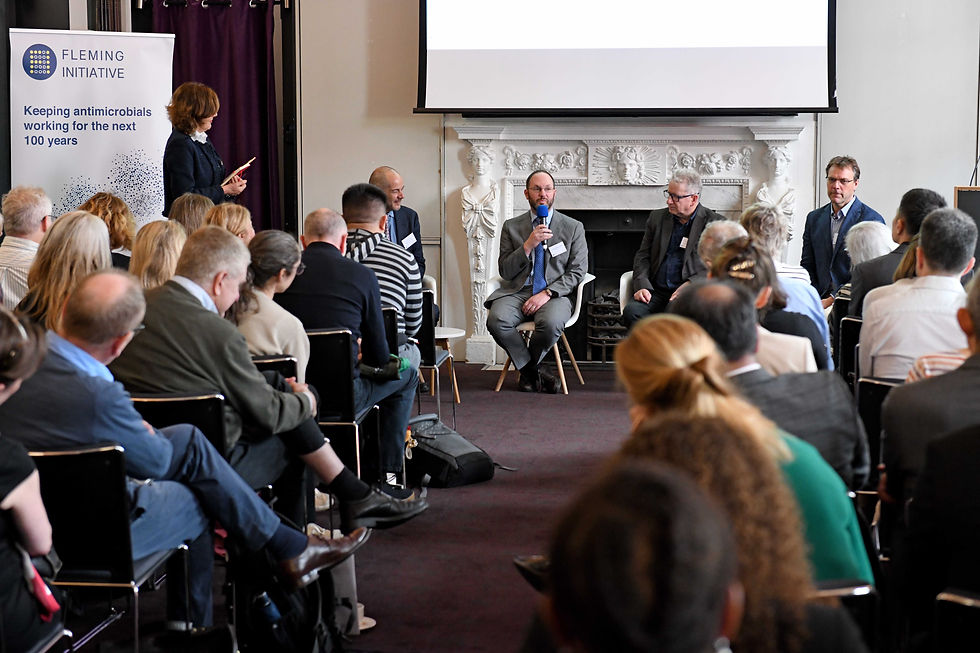
Professor Alison Holmes, Director of the Fleming Initiative, said:
“Fungal diseases and antifungal resistance have not received the attention or investment they require, despite posing a growing threat to global health. At the same time, advances in artificial intelligence, genomics and chemical biology are opening up entirely new possibilities for discovering desperately needed antifungal medicines. To translate these scientific advances into real-world impact, we need stronger partnerships, shared research resources and a research ecosystem that enables innovation.
"The conversations at our recent Fungal Science Summit demonstrated the momentum that is building across this field. Our role at the Fleming Initiative is to sustain that momentum by connecting people, disciplines and organisations, creating the conditions for new collaborations and accelerating progress towards the next generation of antifungal treatments.”
Dr David Payne, VP Infectious Diseases Research at GSK, said:
“When we established our partnership with the Fleming Initiative, one of the aims was to catalyse innovation and draw further investment into critical areas of antimicrobial resistance research. We are incredibly pleased that the work we’re doing to accelerate antifungal drug discovery has attracted significant new funding from Wellcome – an example of that vision coming to life. Expanding the focus to include Candida auris is a crucial development, and the innovative, AI-driven approach being taken is exactly the kind of science needed to tackle the urgent threat of antifungal resistance.”
Megan Neary, Research Lead for Therapeutics at Wellcome, said:
"To address the growing threat of antifungal resistance, it’s important that we invest in bold and innovative new approaches such as this partnership bringing together researchers at the cutting-edge of drug development. We’re excited to support this collaboration, which will build knowledge, create tools and foster partnerships that could help unlock future advances for patients."


